

BBB A+ | Free Shipping | Lifetime Warranty
Est. 2014 | USA Small Business
 Clovis, California
CAGE: 9FAL3
Clovis, California
CAGE: 9FAL3When split seconds dictate the outcome of a defensive encounter, your optic must deliver immediate target acquisition and absolute, undisputed reliability. A holographic weapon sight is engineered specifically for these high-stress, rapid-fire scenarios. Whether you are a law enforcement agent responding to a critical incident, a military operator deployed overseas, a hunter tracking fast-moving game in dense brush, or a civilian preparing a rifle for home defense, understanding the hard facts behind this technology will dictate how you build your loadout.
This is not a traditional magnified scope, and it is not a standard red dot. It is a highly specialized piece of equipment designed to give shooters a distinct physiological and mechanical advantage when engaging targets at close to medium ranges.
The correct technical term used by manufacturers and armorers is holographic weapon sight. However, in the field, operators, tactical instructors, and civilian shooters use several common variations to describe the exact same piece of gear.
Terms like holosight, holo sight, and holo sights are standard shorthand used across the shooting and tactical industry. You will also frequently hear people at the range call them a holographic scope or a holographic optic. In recent years, newer shooters have begun looking for a halo sight or halo sights. This specific terminology was heavily popularized by modern video games that feature optics that look and function similarly to real-world models.
No matter what specific terminology you use—whether you are searching for a true hologram sight, a fast-acquisition holo dot sight, or the most reliable holographic optics on the market—we stock the best duty-rated options built strictly for real-world application.
If you are upgrading your rifle, you need to understand exactly what you are bolting onto your upper receiver. Answering the core question of what is a holographic sight requires looking past the front piece of glass and examining the complex internal mechanics.
At its core, it is a non-magnifying electronic gunsight. It allows the user to look through a rectangular glass window and see a three-dimensional reticle image superimposed perfectly on the target's field of view.
So, how do holographic sights work in practice? Inside the heavy-duty aluminum housing, a specialized laser diode illuminates a piece of holographic film. This internal mechanism bounces the laser light off a series of internal mirrors to reconstruct a 3D reticle.
Unlike simple reflections found in standard red dots, this holographic optical system projects the reticle so it appears to be floating out in front of your weapon, exactly at the target's distance. This means your eyes do not have to shift focus back and forth between your target and your dot. Your eyes remain focused exclusively on the threat.
Because these optics use highly advanced technology, new users are often surprised by what they see when they look through the glass. The reticle is formed by intersecting coherent laser light waves. Because of this, it will naturally look grainy, fuzzy, or composed of tiny shimmering pixels. This visual phenomenon is called laser speckle.
This is not a manufacturing defect, nor does it indicate a broken holo scope. To fix the fuzzy appearance, you must focus entirely on the target. If you stare directly at the reticle on the glass, the perceived blur increases. When you look through the reticle and focus past the glass onto your target, your brain and fovea resolve the image cleanly, making it sharp and highly usable.
A massive marketing myth surrounds these optics regarding how they perform under a magnifier. You will often hear people say that standard red dots magnify with the target, while a holographic dot defies optical physics and remains the exact same size. This is scientifically false.
When an afocal magnifier is placed behind any unmagnified optic, it enlarges everything in its field of view. If a 3x magnifier is deployed, the target is magnified three times, and the reticle is magnified three times. All reticles magnify at the exact same proportional rate as the target.
The true advantage is not a defiance of physics, but rather the reality that a laser can generate a much finer starting point. Because the laser creates a precise 1 MOA dot, a 1 MOA dot magnified 3x covers exactly 3 inches at 100 yards. Conversely, a standard 2 MOA LED dot magnified 3x covers 6 inches of the target at 100 yards. Starting with a smaller dot yields superior precision at long ranges.
The holographic sight vs red dot debate is the most common technical question we receive. While they may look similar, their internal mechanics, power draw, and real-world performance are entirely different.
A standard red dot uses a simple LED light reflecting off a piece of angled glass. A holographic model uses complex lasers and internal mirrors. We break down the exact differences in the comparison table below.
|
Feature |
Holographic Weapon Sight |
Standard Red Dot Sight |
|
Light Source |
Laser diode emitting coherent light. |
Light Emitting Diode emitting non-coherent light. |
|
Target Focus |
Appears projected at the target's exact distance. |
Appears focused precisely at the physical glass window. |
|
Survivability |
Reticle functions even if the front glass is shattered. |
If the front glass breaks, the LED has no surface to reflect on. |
|
Power Consumption |
High current draw; laser diodes inherently require significant energy. |
Extremely low current draw; highly efficient LED circuitry. |
|
Battery Life |
500 to 1,500 continuous hours. |
20,000 to 50,000 continuous hours. |
While the holosights provide unmatched survivability and a better sight picture for those with astigmatism, they come with an engineering trade-off: heavy power consumption. Because lasers draw massive amounts of energy, you must check your batteries routinely and replace them annually to prevent failures.
When selecting the best holographic sight, you must also consider how high it sits on your rifle. This is referred to as the optical centerline.
Historically, shooters used a "lower 1/3 co-witness" height, which measures approximately 1.57 to 1.73 inches above the rail. This allowed the optic to clear fixed iron sights. However, modern tactical application has pushed the industry toward extreme high mounts measuring 1.93 and 2.26 inches.
When a shooter wears a heavy plate carrier, a ballistic helmet, or large over-the-ear active hearing protection, achieving a tight cheek weld down onto the rifle stock compresses the neck. A 2.26-inch centerline allows for a natural "heads-up" posture. You bring the rifle up to your eye, rather than crunching your head down. This prevents neck strain and is an absolute operational necessity for clearing bulky plate carriers or passively aiming through night vision goggles.
The top manufacturers build their optics to survive battlefield conditions, encasing the internal lasers in aircraft-grade aluminum.
We recognize that true holographic optics are inherently expensive due to the complex internal laser diodes and mirrors. If your budget does not allow for a $600 to $900 investment, there are excellent alternative technologies.
In recent years, manufacturers have developed advanced LED reflex sights that mimic the form factor and reticle design of holographic models. The Holosun HS510C and the enclosed-emitter Holosun AEMS are prime examples. These optics feature the large, rectangular viewing windows and utilize a multi-reticle system projecting a 65 MOA outer ring and a 2 MOA central dot. Because they use LEDs rather than lasers, they boast battery lives of up to 50,000 hours, feature solar failsafes, and incorporate shake-awake technology at nearly half the price.
Because these optics are highly sought after, the secondary market is heavily saturated with overseas counterfeits. Counterfeiters replicate the external aluminum housings with near-perfect aesthetic accuracy. However, they invariably fail to replicate the internal laser physics.
To ensure your loadout is Mil-Spec and ready for duty, use these field-expedient tests to detect a counterfeit:
By understanding the physics, identifying the correct optical centerline for your gear, and knowing how to spot a fake, you guarantee that your weapon is always ready for deployment.
Holographic weapon sight (23 Results)


DOT EHS-1 Holographic Sight: The Ultimate 1 MOA / 65 MOA Optic for a Natural Heads-Up Shooting Posture and NODs-Ready Performance The DOT Enhanced...
View full details

DOT EHS-1 L Holographic Sight | Tactical Holographic Optic w/ 1000 Hour Runtime & Dynamic Wake Maintain absolute zero on your primary-duty ri...
View full details

The XPS3 is smaller and lighter than all other holographic weapon sights but just as fast. Law enforcement officers and hunters appreciate the lig...
View full details
The HWS EXPS3-0 is an excellent choice for professionals. The EXPS3 offers true two eyes open shooting for fast target acquisition, night vision co...
View full details
The HHS IX pairs the EXPS3-DCR holographic sight with the G45 magnifier to deliver rapid CQB performance and precision out to extended distances. A...
View full details

The E is for Extreme. The EXPS3 offers true 2-eyes-open shooting and a 7 mm raised base that still allows for iron sight access. It features easy-t...
View full detailsThe EOTECH HHS UNITY 1 pairs the battle-proven EXPS3-0 and G33 magnifier with the UNITY FAST FTC OMNI Mount and FAST Optic Riser, enabling rapid tr...
View full details
The shortest and lightest HWS compatible with night vision yet. Powered by a single transverse-mounted CR123 lithium battery, the XPS3 provides add...
View full details

The XPS2 is the shortest, smallest and lightest EOTECH model holographic weapon sight available without night vision. Its size and weight make it c...
View full details
Now with an easy-to-see Green reticle, the XPS is the shortest and lightest HWS sight yet. The Green reticle is approximately 6X easier to see than...
View full details
The XPS2 is the shortest, smallest and lightest EOTECH model holographic weapon sight available without night vision. Its size and weight make it c...
View full details

The XPS2 is the shortest, smallest and lightest EOTECH model holographic weapon sight available without night vision. Its size and weight make it c...
View full details
A classic pair with modern updates! The HWS EXPS2 maximizes rail space with its compact size and allows for co-witnessing of iron sights. It has co...
View full detailsThe Holographic Hybrid Sight V (HHS V), featuring a EXPS3-4 with a G45 magnifier combination is the perfect solution for Close-Quarters Combat situ...
View full details
The Holographic Hybrid Sight II (HHS II) has an EXPS2-2 with a G33.STS magnifier. Regardless of the scenario, it provides an unparalleled advantage...
View full detailsThe EXPS3 HD advances EOTECH's legacy of holographic excellence, integrating a side rotary dial, adaptive auto-brightness, and rapid-activation sha...
View full details
The EXPS3-DCR features the Danger Close Reticle (DCR) that provides fast and accurate shots at typical distances but also an effective close combat...
View full details
Achieve faster target acquisition with the new easy-to-see Green reticle that is approximately 6X easier to see than red in daytime. The EXPS2-GRN ...
View full details

The EXPS2 offers true 2-eyes-open shooting and provides an unparalleled targeting experience. The all-purpose EXPS2 features easy-to-adjust side b...
View full details
Perfect for anyone that doesn't like to sacrifice. The 558 is compatible with Gen-I-III night vision devices and features an adjustable, locking qu...
View full details
Are you a sportsman interested in hunting with night vision? Give the 552 another look. The 552 is EOTECH's most affordable night vision-compatib...
View full details
The best just got better. The 518 runs on easy to find AA batteries but offers all of the features found in EOTECH's EXPS top of the line sight. W...
View full details
Model 512 is EOTECH's most popular holographic weapon sight. It's ideal when you need the best in speed and versatility, without night vision compa...
View full details






11/10! The small touches made such a big impact, like the patch, stickers and jolly ranchers were something I am beyond grateful for! Amazing product! Great price, very much satisfied.
C. Nelson

If you want updates regularly, just shoot Atomic Defense a message. They always respond quickly and answer any questions you have and can clarify. (*Modified for read-ability and formatting.)
S. Stocker
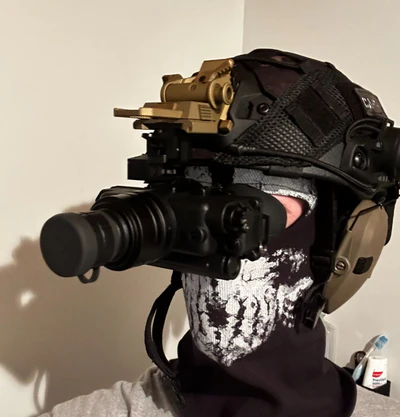
It's comfortable, like 8.9/10. I'm happy I went with Atomic Defense. Genuine equipment you can trust your life with.(*Modified for read-ability and formatting.)
C. Flick


