

BBB A+ | Free Shipping | Lifetime Warranty
Est. 2014 | USA Small Business

A night vision set provides you with the exact equipment needed to safely navigate, spot targets, and finish your mission in low-light environments. Whether you are an officer protecting an urban perimeter or a civilian focused on home defense, having the right tactical gear is key to your safety.
Most buyers group everything under one label, but traditional night vision, digital systems, and thermal imaging operate on completely different principles. Traditional image-intensifier systems collect existing ambient light and amplify it thousands of times to create a glowing green image. Meanwhile, a thermal night vision setup detects infrared radiation emitted by objects, allowing you to see heat in total darkness.
|
Device Type |
How it Works |
Best Environment |
|
Traditional Night Vision |
Amplifies available ambient light. |
Moderate low-light, navigation under moonlight. |
|
Thermal Imaging |
Detects infrared radiation (heat). |
Total darkness, heavy fog, or spotting hidden targets. |
|
Digital Night Vision |
Uses camera sensors and often IR illuminators. |
Mixed lighting conditions or when recording video are needed. |
Building the right rig can be confusing. We created this Best Night Vision Goggles Guide to help you put together the perfect loadout. Here are the most common night vision setups and exactly what you need to build them:
Before you start searching for NV goggles for sale, understanding the underlying technology is critical. Knowing how these devices process light will help you choose between budget and professional night vision systems for your specific mission.
Before you start searching for NV goggles for sale, understanding the underlying technology is critical. Knowing how these devices process light will help you choose between budget and professional night vision systems for your specific mission.
Once you understand the internal technology, deciding on the physical housing of your optics is the next major step. Your choice of housing will dictate your situational awareness and how you interact with your environment during a night operation.
The final piece of the puzzle is understanding the specific tube metrics and display colors that affect your actual viewing experience. Knowing how to read these specifications ensures you get exactly what you need when investing in high-end tactical gear.
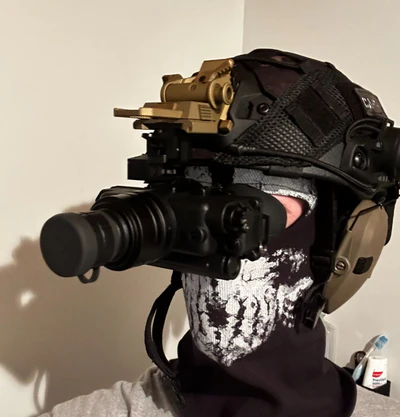
When building a night vision setup helmet, the very first thing you must decide is the level of protection you need. This usually comes down to choosing between a ballistic and a non-ballistic helmet. Your choice will depend entirely on your environment, the weight you are willing to carry, and the specific threats you expect to face in the dark.
To build the perfect night vision headset, you need to match your helmet's base perfectly with the correct mounts and goggles. Understanding how these mechanical parts connect ensures your gear stays rock-solid while you move.
Additionally, when connecting your night vision goggles (NVGs) to a mounting arm, you must choose the right attachment interface. This connection is crucial for keeping your gear secure while you move.
Even with a lightweight mount, night vision devices are heavy. When you hang them off the front of your face, your helmet will naturally tip forward, pulling down on your forehead and causing severe neck strain over time.
Here’s a sample guide on how operators would commonly build out a complete Night Vision Set:
|
Setup Goal |
Helmet Type |
Mount System |
Night Vision Goggles |
Counterweight Match |
|
Tactical & Duty |
Ops-Core FAST SF or PGD ARCH GEN3 Ballistic Helmet |
Wilcox G24 (Eliminates wobble during movement) |
Dual Tube NVGs (For maximum depth perception and awareness) |
|
|
Hunting & Tracking |
Team Wendy EXFIL or Lightweight Bump Helmets |
PVS-14 Night Vision Monocular (Perfect for a night vision hunting setup) |
||
|
Surveillance / Airsoft |
Budget Tactical Bump Helmet |
Basic Night Vision Rhino Mount or Picatinny Rail Mounts |
Fixed Digital Night Vision Systems or a cheap night vision set |
Standard MOLLE Night Vision Counterweight Pouch |
If you are wondering where to buy top-tier, reliable tactical equipment, look no further than Atomic Defense. We carry industry-leading manufacturers and offer components that perfectly fit together out of the box. Whether you need a simple bump helmet for a weekend hunt or a fully integrated ballistic helmet for professional duty, our store offers competitive pricing, expert support, and fast shipping. Explore our collection to find your perfect match today.
Vertx Siege 25L: The Ultimate Mission Pack for Rapid CCW Access & Expandable Storage The Vertx Siege 25L Tactical Backpack is a mission-capabl...
View full details





11/10! The small touches made such a big impact, like the patch, stickers and jolly ranchers were something I am beyond grateful for! Amazing product! Great price, very much satisfied.
C. Nelson

If you want updates regularly, just shoot Atomic Defense a message. They always respond quickly and answer any questions you have and can clarify. (*Modified for read-ability and formatting.)
S. Stocker
It's comfortable, like 8.9/10. I'm happy I went with Atomic Defense. Genuine equipment you can trust your life with.(*Modified for read-ability and formatting.)
C. Flick
They are extremely knowledgeable about the products they sell and shipped out quickly
Excellent products across the board. 100% recommended. I have purchased several times and really like the quality of the materials and the products they offer.
These plates are extra comfortable to me and replaced my old gear. Great armor
Great training tool feels like a real weapon
I’ve tried a few different lights surefire stiletto pro II Surefire edcl2-t and a few streetlights this has been my favorite thus far it’s an excellent task light if that’s what your looking for I can’t speak for longevity yet but my surefires in the past have been nothing but reliable
Item was just as described and was the best price I could find plus free shipping. You can't beat that!
Great price Free Shipping Overall great experience with Atomic Defense.
These helped immediately fix an alignment issue I had been having. Solid product.
Got greats stickers & as charlie day would say “good candy , good candy!” Package was shipped fast and my wife really did love the candy. Will order mote stuff from atomic defense indeed!
Love ordering from Atomic. Great prices and super quick service.
They work great and add a little aesthetic to your gun. I thought they were actually a little bigger so i should have ordered more.
Great price on Comtac viii and fast shipping. These guys are my go to for gear.
Amazing as always from Crye and Atomic!!🇺🇸


